Regenerative Medicine
Osteoarthritis beyond pain: what science is discovering about the Wnt pathway and the DKK-1 protein
Learn what happens in osteoarthritis beyond cartilage wear and discover the role of the Wnt pathway, the DKK-1 protein and new research in regenerative medicine.
September 23, 2026

Osteoarthritis does not happen overnight. Long before a joint loses function or surgery enters the discussion, a series of biological changes may already be taking place inside it. Among the mechanisms drawing scientific interest are the Wnt signaling pathway and a protein still little known outside research centers: DKK-1.
For many people, osteoarthritis is still synonymous with “cartilage wear.” This explanation is easy to understand, but today we know it is incomplete.
Osteoarthritis, also called OA, is a chronic disease that can involve different structures of the joint. In addition to cartilage degradation, there may be inflammation of the synovial membrane, changes in the bone beneath the cartilage and the formation of osteophytes.
In practice, this can show up as pain, stiffness, reduced mobility, swelling, cracking sounds and growing difficulty with activities that used to be part of daily life. Loss of function can compromise independence and quality of life.
That is why talking about osteoarthritis only when pain has become severe, or when surgery is already on the table, means looking at a progressive disease only at a more advanced stage of its course.
Osteoarthritis is more than “worn cartilage”
For many years, the popular explanation for osteoarthritis was almost mechanical: with age and use, cartilage would wear away.
Today, science looks at the disease much more broadly.
Age, excess weight, joint injuries and biomechanical changes are among the factors associated with OA. But researchers have also been studying the cellular and molecular mechanisms involved in its progression.
This is exactly where a topic little known to the public comes in: communication between the cells of the joint.
Our body has several cell signaling pathways. We can think of them as communication systems that tell cells when to grow, differentiate, produce certain substances or respond to changes in their environment.
One of these pathways is called Wnt.
What is the Wnt pathway?
The Wnt pathway takes part in many biological processes and is also involved in maintaining joint tissues.
When its activity changes, it can affect the behavior of chondrocytes (the cartilage cells), the synovium and the subchondral bone.
Experimental research shows something particularly interesting: balance appears to be essential.
Excessive activation of Wnt signaling may favor changes associated with cartilage degradation. On the other hand, excessive suppression of the same pathway can also be harmful. In other words, it is not simply a matter of switching Wnt “on” or “off”: joint homeostasis depends on far more sophisticated regulation.
That is precisely why the Wnt pathway has come to be studied as a possible target for new strategies in osteoarthritis.
And it is within this system that we find DKK-1.
So, what is DKK-1?
DKK-1 is short for Dickkopf-1, a protein naturally produced by the body.
It acts as one of the regulators of the Wnt/β-catenin pathway, interacting with receptors involved in this signaling and potentially reducing its activation.
It may sound like a detail of molecular biology, but this interaction is being investigated because the Wnt pathway takes part in processes related to cartilage, bone and joint remodeling.
A study of patients with knee osteoarthritis found significantly lower plasma concentrations of DKK-1 in patients with OA than in healthy controls. In addition, within the osteoarthritis group, lower DKK-1 levels were associated with greater radiographic severity of the disease.
It is an interesting finding, but it is important to understand correctly what it means.
Association is not the same as causation.
The study does not show that simply increasing DKK-1 will stop osteoarthritis from progressing. It does, however, support the hypothesis that this protein and the regulation of the Wnt pathway take part in the complex biology of the disease and deserve investigation.
This careful interpretation is especially important because Wnt activity needs to remain balanced, and the effects of DKK-1 may vary depending on the tissue, the biological context and the condition being studied.
And what do platelets have to do with DKK-1?
This is where the story gets even more interesting.
Platelets are best known for their role in blood clotting, but they also store and release many biologically active molecules.
Studies have shown that activated platelets can release DKK-1. In laboratory experiments, platelet activation triggered a rapid release of this protein. This observation opens a new line of investigation within autologous therapies, those produced from the patient’s own blood.
It also helps explain why regenerative medicine is no longer looking only at the number of platelets and is starting to investigate which molecules are released, at what concentration and through which biological mechanisms they may act.
From conventional PRP to targeted biological modulation
PRP (platelet rich plasma) is already known across different fields of medicine.
But concentrating platelets does not necessarily mean always obtaining the same biological product. Preparation method, cell concentration, activation method and final composition can differ between technologies.
This is precisely where devices designed to explore specific mechanisms of platelet activation come in.
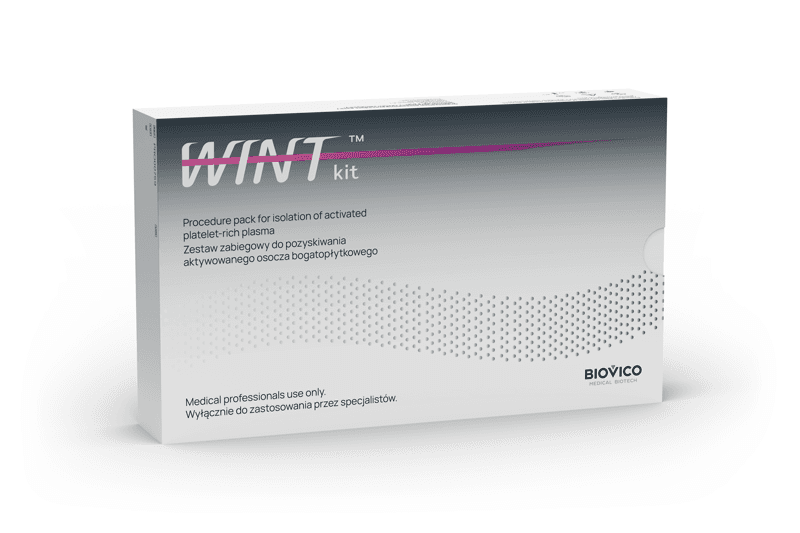
WINT™, a Biovico technology available in Brazil through Rooter Medical, uses an autologous blood separation system with borosilicate beads designed for the selective activation of platelets. According to the manufacturer’s technical documentation, this activation promotes the release of DKK-1 and yields an autologous product enriched in this protein.
The technical material also presents experimental results showing a reduction in β-catenin and in the expression of genes associated with Wnt signaling after use of the product obtained with the system.
These data are relevant for understanding the biological rationale of the technology, but they should not be interpreted on their own as proof of prevention, reversal or cure of osteoarthritis.
This distinction is essential.
Is it possible to stop osteoarthritis from progressing?
This will probably be one of the most important questions of the coming years.
Today, it would be incorrect to claim that there is a therapy able to simply “switch off” osteoarthritis or to regenerate an already degenerated joint with any guarantee.
At the same time, research is moving from a model focused almost exclusively on symptom control toward a much deeper understanding of the mechanisms involved in the disease.
The Wnt pathway itself is already being investigated as a therapeutic target. Clinical studies with other molecules that modulate this signaling have shown that interfering with this system is a real line of research in osteoarthritis.
This does not mean that all technologies acting directly or indirectly on Wnt are equivalent. It means that understanding and modulating the biological mechanisms of osteoarthritis is today an important scientific frontier.
Is osteoarthritis treatment changing?
Perhaps the biggest change lies in the question itself.
For a long time, the conversation was: “How do we control this patient’s pain?”
Science is beginning to allow broader questions:
- What is happening biologically inside this joint?
- Is it possible to preserve function for longer?
- Which patients may benefit from nonsurgical strategies?
- Is it possible to better understand the mechanisms involved in disease progression?
Medication, physical therapy, weight management when indicated, guided physical activity, viscosupplementation with hyaluronic acid, autologous therapies and other approaches may be part of management, depending on the patient and the medical assessment.
There is no single strategy that is right for everyone.
But there is an important shift in perspective: osteoarthritis does not have to be a conversation that starts only once mobility has already been lost.
The sooner we understand the disease, its risk factors and its management options, the greater our ability to discuss preserving function and quality of life over the years.
And among the new frontiers of this discussion, Wnt and DKK-1 are two names we will probably hear more and more.
Responsible information is also part of innovation
At Rooter Medical, we believe that bringing new technologies to market must go hand in hand with scientific education and access to quality information.
That is why this is the first piece in a series dedicated to osteoarthritis, mobility preservation, regenerative medicine and the new frontiers of joint science.
In upcoming articles, we will explain in accessible terms topics such as hyaluronic acid, PRP, autologous therapies, DKK-1, the Wnt pathway and the differences between technologies currently used to treat osteoarthritis.
This content is for informational and educational purposes only and does not replace medical evaluation, diagnosis or advice.
References
- Lories RJ, Monteagudo S. Is Wnt Signaling an Attractive Target for the Treatment of Osteoarthritis? Rheumatology and Therapy. 2020;7:259-270. DOI
About the author
Rooter Medical
Brazilian distributor of surgical implants, biomaterials, OPME and regenerative medicine. World class technology and technical support for surgeons, hospitals and health insurers.