Viscosupplementation
One injection or several? Understanding the different hyaluronic acid protocols for the knee
Single or multiple injections? Learn why the number of injections alone does not define the best hyaluronic acid treatment for the knee, and what should be compared.
October 15, 2026

People who are recommended viscosupplementation for knee osteoarthritis often quickly arrive at the same question: will I need one injection or several?
The question matters because there are now hyaluronic acid formulations developed for a single injection and others used in multiple injection protocols, usually spread over a few weeks.
But the number of injections alone does not determine whether a treatment is better, stronger or more effective. In fact, before counting how many times the procedure will be performed, it is necessary to understand which hyaluronic acid is being used, how much will be administered and what evidence exists for that formulation and that protocol.
One injection or several: why are there different protocols?
For many years, viscosupplementation was associated mainly with protocols of three to five injections. Later, formulations developed for administration in a single injection emerged. Today, both strategies coexist in clinical practice and in the scientific literature.
This happens because not all hyaluronic acid is the same.
As we explained earlier on this blog, formulations differ in characteristics such as:
- concentration;
- molecular weight;
- volume administered;
- viscosity;
- molecular structure;
- total dose of hyaluronic acid;
- administration protocol.
That is why simply saying that one treatment uses one injection and another uses three is not enough to compare them.
The number of syringes is not the same as the dose.
One formulation may have been developed to deliver a given dose in a single administration, while another may use a protocol in which the treatment is spread across several injections. These are different viscosupplementation strategies.
Is one injection better than three?
Not necessarily, and the opposite is not true either.
This is probably one of the most important points for patients to understand.
The scientific literature comparing different viscosupplementation regimens does not establish a simple rule that “fewer injections are better” or “more injections are better.” A systematic review published in 2019 (McElheny et al., 2019) analyzed studies comparing different hyaluronic acid regimens for knee osteoarthritis. Among the studies that directly compared single injection and multiple injection formulations, no consistent difference was found in patient reported outcomes. The authors also noted that there are still relatively few direct comparative studies between the different regimens.
A meta-analysis dedicated specifically to single injection formulations (Vincent, 2019), covering more than 4,000 patients, found pain reduction with a single injection and concluded that its results were similar to those historically observed with multiple injection regimens, while acknowledging the methodological limitations of this comparison.
In other words: science does not allow a protocol to be chosen simply by counting injections.
So what should be compared?
Imagine two treatments described only in this way:
- Treatment A: one injection.
- Treatment B: three injections.
We still know very little about them. A proper comparison would require knowing at least the formulation used, the hyaluronic acid concentration, the volume administered in each procedure, the total dose delivered by the end of the protocol, its physicochemical properties and the available clinical evidence.
This distinction is particularly important because studies on viscosupplementation involve different products.
Therefore, the result found with one formulation should not automatically be transferred to any other hyaluronic acid just because both are administered in one or in several injections. The evidence must follow the formulation studied.
What about volume? Do 2 mL, 3 mL, 4.8 mL or 6 mL make a difference?
This is another interesting question, especially when we are talking about a large joint such as the knee.
There are products with different volumes, just as there are different concentrations and total doses. But here, too, it is important to avoid oversimplifying. A larger volume does not automatically mean greater effectiveness, just as a smaller volume does not necessarily mean there is insufficient product inside the joint. Volume should be interpreted together with concentration, the total amount of hyaluronic acid, the characteristics of the formulation and the protocol for which that product was developed.
For example, a syringe with a larger volume and lower concentration may deliver a smaller total dose than a syringe with a smaller volume and higher concentration. That is why looking only at the milliliters, once again, tells only part of the story.
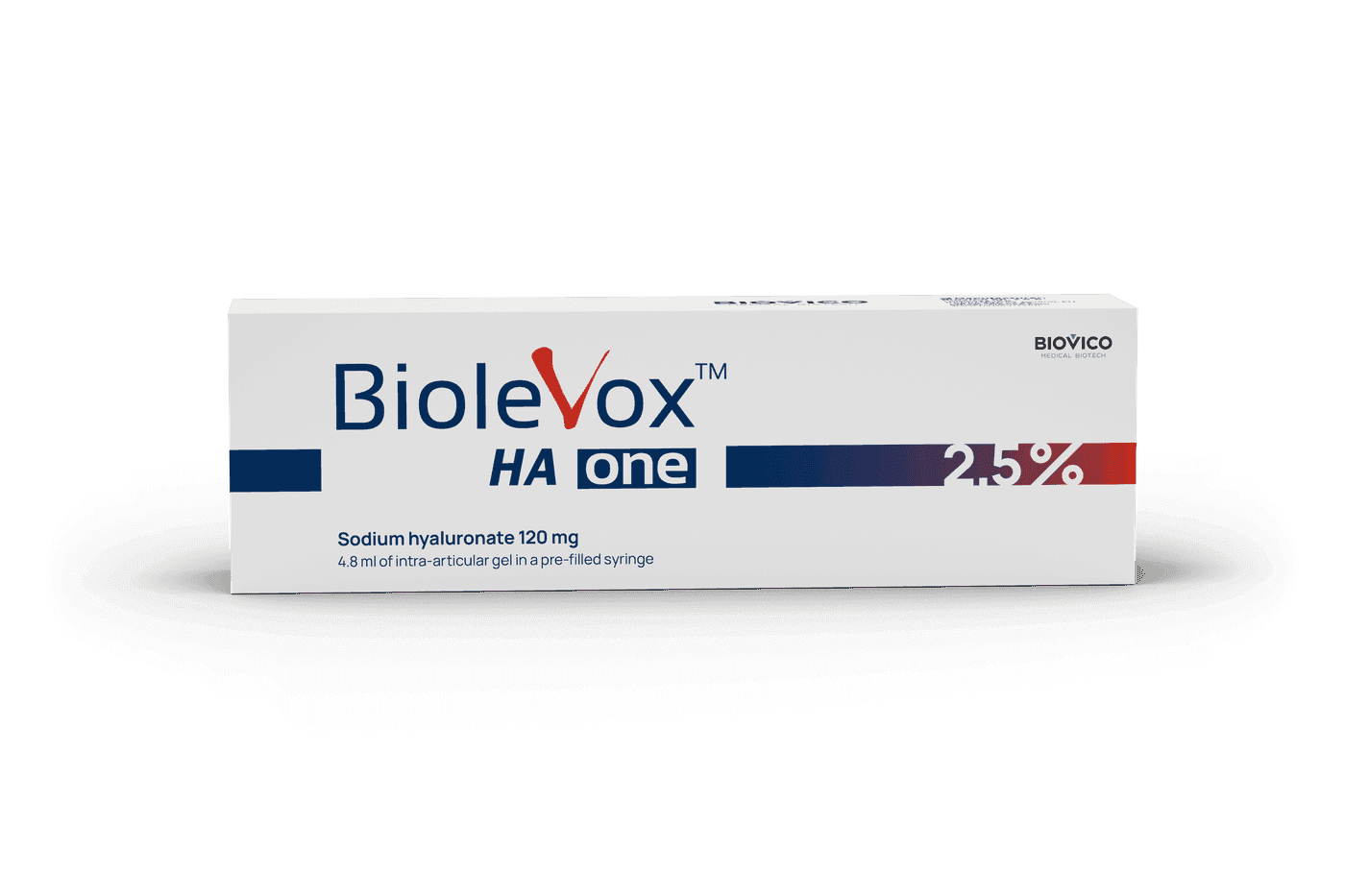
In the case of Biolevox™ HA ONE, for example, the formulation comes in 4.8 mL and was developed for intra-articular administration, including large joints such as the knee, hip and shoulder. Its documentation describes high molecular weight sodium hyaluronate, produced by biofermentation and not of animal origin (Biolevox™ HA ONE: technical material and Brazilian documentation).
Therefore, when it comes to joint size, volume is a relevant variable of the formulation, but it should not be analyzed in isolation or used to conclude that a given volume is necessarily superior to another.
For the patient, there is also a question of convenience
Here a very concrete difference between the protocols appears.
A treatment performed in a single injection and a treatment performed in three injections can be different experiences for the patient, even when both are clinically appropriate.
A multiple injection protocol may require scheduled return visits to the office or health service to complete the treatment.
A single injection strategy concentrates administration in a single procedure.
That is why, depending on the product, the patient and the indication, factors such as availability, travel, work routine, the need for return visits and the patient’s own preference can also be part of the shared decision.
A systematic review comparing viscosupplementation regimens (McElheny et al., 2019) pointed precisely to the possibility of less inconvenience for the patient with single injection formulations, although it did not find consistent clinical superiority of one regimen over the other in the comparative studies available.
Convenience, however, should not be confused with effectiveness. A protocol may be more convenient for a particular patient without being, for that reason, universally better.
And there is a second journey: that of the health system
Each intra-articular injection is also a care event.
Depending on how the treatment is performed, it may involve the use of an office or hospital facilities, staff, supplies, the procedure itself, possible imaging guidance and the patient’s return. That is why, when different strategies are clinically appropriate, the number of interventions can also be part of the analysis.
But, once again, there is an important caveat: fewer injections do not automatically mean a lower total cost. Just as a cheaper syringe does not necessarily mean a more economical treatment.
To understand the impact of a given strategy, it would be necessary to consider the complete protocol, the resources used to carry it out, any need to repeat the treatment and, above all, the clinical results achieved.
It is a seemingly small change in the question: instead of asking only “how much does this syringe cost?”, one starts to ask:
“What does it take to complete this treatment, and what result does it deliver?”
An example of a formulation developed for a single injection
Biolevox™ HA ONE is a single injection formulation containing 120 mg of sodium hyaluronate in 4.8 mL, corresponding to 25 mg/mL (2.5%). Its technical material states a molecular weight of 3,200 kDa and a viscosity of 650 Pa·s (Biolevox™ HA ONE: technical material and Brazilian documentation).
These numbers describe the product. But there is another equally important question: has this formulation been clinically studied in this way?
In the case of Biolevox™ HA ONE, yes.
A study published in 2025 (Biolevox™ HA ONE clinical study, Multidisciplinary Pain Journal, 2025) evaluated 148 patients with knee osteoarthritis treated with a single intra-articular injection of 4.8 mL containing 120 mg of hyaluronic acid. One hundred forty patients completed one year of follow up. Assessments at 3, 6 and 12 months showed a statistically significant improvement in pain and physical function compared with baseline values. The study was open, multicenter and noncomparative, and was conducted in routine clinical practice. The study provides clinical evidence specific to that formulation used as a single injection and followed for 12 months. It does not show that every single injection will have the same result. Likewise, studies of products administered in three or five injections must be interpreted according to the formulation and protocol actually studied.
Can one injection last 12 months? And can three?
This question needs to be answered carefully.
The number of injections alone does not determine how long the clinical benefit lasts. There are different formulations and protocols, and the duration observed must be demonstrated in the studies of each product.
It is also important to distinguish two things: how long hyaluronic acid physically remains in the joint and how long the clinical benefit observed in the patient lasts are not necessarily the same thing.
In the study mentioned above with Biolevox™ HA ONE (Multidisciplinary Pain Journal, 2025), patients were followed for 12 months and their clinical results remained significantly better than baseline values throughout that period.
Likewise, multiple injection protocols may show prolonged clinical benefit when this is supported by the evidence for the respective formulation.
That is why the right question is not simply:
“How many injections are needed for it to last longer?”
But rather:
“What is the evidence on how long the benefit lasts for the product and protocol being proposed?”
Does viscosupplementation need to be repeated every year?
There is no universal answer here either.
In clinical practice, there may be new cycles of viscosupplementation when there is a medical indication and symptoms return. Medical sources aimed at patients often describe the possibility of repeating protocols at certain intervals, but the decision depends on the individual response, the formulation used, the progression of osteoarthritis and the physician’s assessment.
This means that a multiple injection protocol and the future repetition of a treatment are different concepts.
Three injections given as part of the same protocol are not the same as repeating a new cycle months later. This difference is important so that patients understand exactly the treatment they are receiving.
So what should patients ask before the injection?
More important than arriving at the office looking for one injection or several is understanding why a given strategy is being recommended for that case.
Some questions can make this conversation much clearer:
- Which hyaluronic acid will be used?
- What is its concentration?
- What will be the total dose administered over the whole protocol?
- What is the volume of each injection?
- Does the treatment involve one injection or multiple injections?
- Why was this protocol chosen for my case?
- What clinical evidence exists for this formulation and this protocol?
- For how long was the benefit followed in the studies?
These are simple questions, but they can transform the patient’s participation in the decision.
In the end, it is not a contest between “one” and “several”
Viscosupplementation has evolved, and today there are different strategies available.
There are formulations developed for a single injection and formulations developed for split protocols. Both can have a place in the treatment of osteoarthritis when correctly indicated. That is why reducing the discussion to “one injection is better” or “three injections are better” probably means asking the wrong question.
What matters most is understanding which product is being used, what dose is being delivered, which protocol was studied, what evidence supports that strategy and why it makes sense for that patient.
And there is one more dimension that should not be ignored: the journey required to achieve the result.
For some patients, completing the entire protocol in a single intervention may be an important convenience. For others, a split protocol may be the strategy chosen by the physician.
The goal should not simply be to perform more or fewer injections. It should be to choose the right formulation, in the right protocol, for the right patient, seeking the best clinical result with a coherent care journey.
References
- McElheny K, Toresdahl B, Ling D, Mages K, Asif I. Comparative Effectiveness of Alternative Dosing Regimens of Hyaluronic Acid Injections for Knee Osteoarthritis: A Systematic Review. Sports Health. 2019;11(5):461-466. DOI
- Vincent P. Intra-Articular Hyaluronic Acid in the Symptomatic Treatment of Knee Osteoarthritis: A Meta-Analysis of Single-Injection Products. Current Therapeutic Research. 2019;90:39-51. DOI
- Torres Morera LM, Neira Reina F, Ortega JL, Lozano Sánchez JJ, Calderón E. Eficacia de la inyección intrarticular única de ácido hialurónico con una alta concentración para la osteoartritis de rodilla. 12 meses de seguimiento. Multidisciplinary Pain Journal. 2025;5(1):2-10. DOI
- Biolevox™ HA ONE: technical material and Brazilian documentation. 120 mg/4.8 mL; molecular weight 3,200 kDa; viscosity 650 Pa·s; high molecular weight sodium hyaluronate produced by biofermentation, not of animal origin. ANVISA registration 82416090004. ANVISA
About the author
Rooter Medical
Brazilian distributor of surgical implants, biomaterials, OPME and regenerative medicine. World class technology and technical support for surgeons, hospitals and health insurers.