Viscosupplementation
Intra-articular hyaluronic acid: why concentration, molecular weight and structure matter
Not every hyaluronic acid formulation is the same. Learn how concentration, molecular weight, total dose and structure set products apart, and what the clinical evidence shows.
September 30, 2026

When we talk about hyaluronic acid for intra-articular use, it is common to treat different formulations as if they were equivalent. After all, they all contain hyaluronic acid.
But this simplification overlooks an important part of the science behind viscosupplementation. Concentration, molecular weight, viscosity, chain structure and formulation characteristics can influence the physicochemical and biological properties of hyaluronic acid. That is why, rather than asking whether a formulation “has hyaluronic acid,” it is important to understand which hyaluronic acid is being administered and how it was developed for that application.
This discussion is especially relevant in osteoarthritis, a disease that is not limited to simple “cartilage wear,” but involves changes in different structures and biological processes of the joint.
What happens to hyaluronic acid in osteoarthritis?
Hyaluronic acid is a component naturally present in the body and found in articular cartilage and synovial fluid. In this environment, it contributes to the biomechanical properties of the fluid, supporting lubrication and viscoelasticity.
In osteoarthritis, changes in endogenous hyaluronic acid and in the properties of synovial fluid help explain the principle of viscosupplementation. Intra-articular administration seeks to complement the properties of the synovial fluid compromised by the disease, but its role does not seem to be limited to simply adding a “lubricant” to the joint. The literature describes mechanisms related to maintaining viscoelasticity, modulating inflammatory processes and interacting with cells and extracellular matrix components. Exogenous hyaluronic acid does not fully reproduce every function of endogenous HA, but different biological mechanisms have been studied to explain its effects in osteoarthritis.
This is precisely where the differences between formulations begin.
Molecular weight: the size of the molecule matters
Put simply, molecular weight relates to the length of the hyaluronic acid chains and can influence both their physical properties and their biological interaction with tissues.
One of the mechanisms studied involves the interaction of hyaluronic acid with cell receptors, including CD44, which is involved in communication between HA and cells. And here there is a particularly interesting concept: it is not simply a matter of concluding that “the higher the molecular weight, the better.”
The Biolevox™ technical material describes a rationale of appropriate chain length, able to favor the interaction and clustering of CD44 receptors and to take part in cellular responses related to protecting the joint environment.
Therefore, the central point is not to pursue the highest possible number in isolation, but to understand the formulation as a set of parameters developed for a given clinical purpose.
What about concentration?
Concentration and molecular weight do not mean the same thing.
Put simply:
- Molecular weight relates to the length of the HA chains.
- Concentration indicates how much hyaluronic acid is present in a given volume.
- Total dose indicates how much hyaluronic acid will actually be administered in that injection.
These variables, combined with other formulation characteristics, influence properties such as viscosity and viscoelastic behavior.
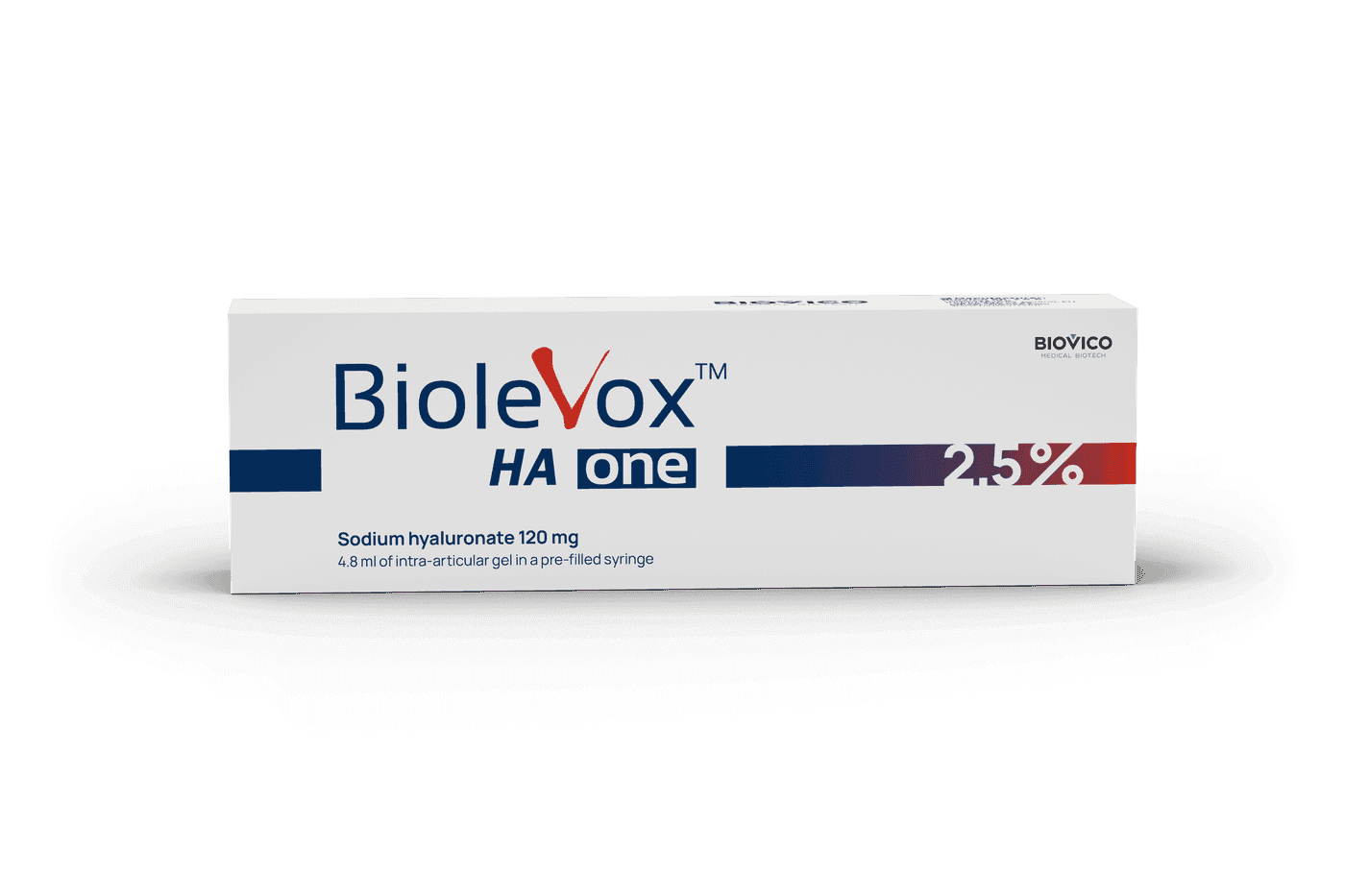
In the case of Biolevox™ HA ONE, the formulation contains 120 mg of sodium hyaluronate in 4.8 mL, with a stated molecular weight of 3,200 kDa and a viscosity of 650 Pa·s. This corresponds to a concentration of 25 mg/mL (2.5%), developed for intra-articular administration as a single dose. The product uses high molecular weight sodium hyaluronate produced by biofermentation and not of animal origin.
And this brings us to another important point: total dose also matters.
Two formulations may both be called “intra-articular hyaluronic acid” and still show important differences in concentration, administered volume, molecular weight, viscosity and total amount of HA delivered to the joint.
That is why comparing products by looking only at the name of the substance can hide relevant differences between formulations.
What does it mean for hyaluronic acid to be crosslinked or non-crosslinked?
Not every injectable hyaluronic acid has the same structure.
In some formulations, the hyaluronic acid chains are linked to one another through a process called crosslinking. Put simply, it is like building “bridges” between these chains, forming a more interconnected structure that is more resistant to degradation.
This strategy can increase how long the material physically remains in the joint. However, there is an important distinction: the time the product physically stays inside the joint is not necessarily the same as the time its clinical benefit can last.
This is where a different approach comes in.
Biolevox™ HA ONE uses non-crosslinked hyaluronic acid. Instead of adding extra bonds between the chains through crosslinking, its formulation relies on selecting different physicochemical parameters of the HA itself, such as molecular weight, concentration, total dose and viscosity.
And why is this relevant?
Because intra-articular hyaluronic acid does not act only as a material that physically fills a space or mechanically “lubricates” the joint. HA also takes part in biological interactions. The literature describes mechanisms related to the synthesis of extracellular matrix components, the modulation of inflammatory mediators and the maintenance of the viscoelastic properties of the joint environment.
The Biolevox™ technical materials also describe mechanisms related to the interaction of HA chains with CD44 receptors, as well as endogenous HA production and the modulation of inflammatory and cellular processes involved in the joint environment.
That is why “crosslinked” and “non-crosslinked” should not be used on their own as synonyms for “better” or “worse,” nor for “long effect” or “short effect.” They are different formulation strategies that need to be assessed together with the other characteristics of the product and, above all, with the clinical evidence for the specific formulation.
And what does the clinical evidence show?
This is precisely where there is an important finding for Biolevox™ HA ONE. A study published in 2025 in the Multidisciplinary Pain Journal evaluated Biolevox™ HA ONE 2.5% (4.8 mL) in patients with knee osteoarthritis.
The study was open, multicenter and noncomparative, and was conducted in routine clinical practice. It included 148 patients aged 32 to 82, of whom 140 completed one year of follow up. All received a single intra-articular injection of 4.8 mL containing 120 mg of hyaluronic acid. Assessments at 3, 6 and 12 months showed a statistically significant reduction in pain and improvement in physical function compared with baseline values, with clinical benefit observed throughout the 12 months of follow up.
It is important to understand exactly what this result means, because it does not mean that the 120 mg of hyaluronic acid remained physically intact inside the joint for a year. It means something clinically relevant and scientifically more precise: a single administration of the studied formulation was associated with sustained clinical benefit over the 12 months evaluated.
This difference is essential: how long the molecule remains and how long the clinical effect lasts are not the same thing.
That is why the clinical duration of a viscosupplementation should not be assumed based only on the presence or absence of crosslinking. It needs to be assessed based on the characteristics of the formulation and demonstrated by the clinical evidence for the product evaluated.
Not all hyaluronic acid is the same
Perhaps this is the main message.
“Hyaluronic acid” describes the substance, but it does not fully describe the formulation.
Molecular weight, concentration, viscosity, volume, total dose, molecular structure and the clinical evidence for the specific formulation need to be considered together. The scientific literature itself recognizes that there are different injectable hyaluronic acid formulations and that this heterogeneity is one of the difficulties in interpreting and comparing results across studies.
So perhaps the question should not be only:
“Does this product contain hyaluronic acid?”
But rather:
“What are the characteristics of this hyaluronic acid, and what clinical evidence exists for this formulation?”
References
- Torres Morera LM, Neira Reina F, Ortega JL, Lozano Sánchez JJ, Calderón E. Eficacia de la inyección intrarticular única de ácido hialurónico con una alta concentración para la osteoartritis de rodilla. 12 meses de seguimiento. Multidisciplinary Pain Journal. 2025;5(1):2-10. DOI
- Biolevox™ HA: product technical material. Technical documentation used for information on the composition and physicochemical parameters of the formulation, including 120 mg/4.8 mL, a molecular weight of 3,200 kDa and a viscosity of 650 Pa·s, as well as the biological mechanisms presented by the manufacturer.
- Regulatory documentation for Biolevox™ HA ONE in Brazil. Product documentation describing a 4.8 mL prefilled syringe of high molecular weight sodium hyaluronate produced by biofermentation, not of animal origin, intended for intra-articular administration. ANVISA registration 82416090004. ANVISA
About the author
Rooter Medical
Brazilian distributor of surgical implants, biomaterials, OPME and regenerative medicine. World class technology and technical support for surgeons, hospitals and health insurers.